
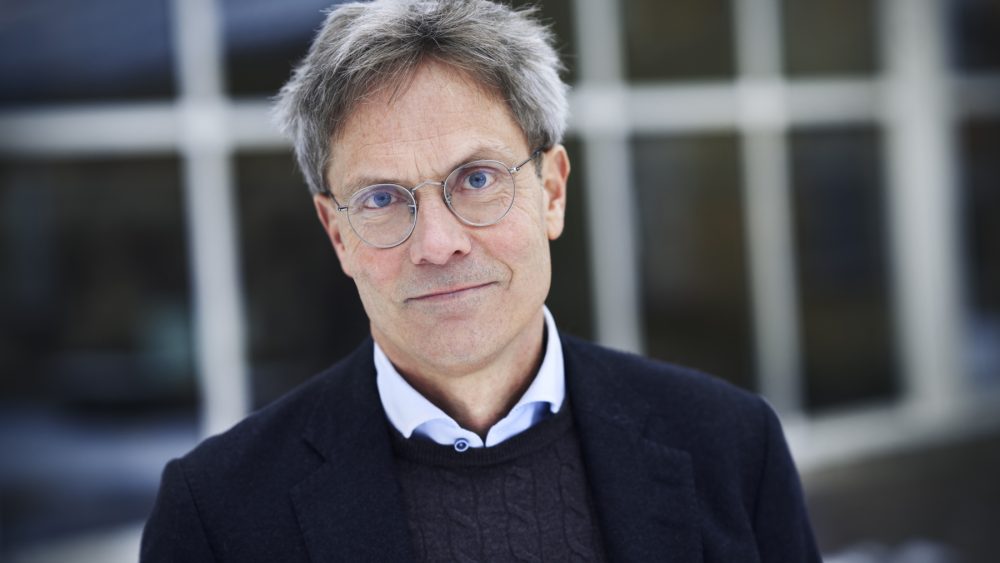
Mats Benner, professor and Academic Lead for the coordination of CCI at Lund University.
A call from Lund University to Universities across Europe to seize the opportunity
All the societal challenges we face are complex and require expertise across many fields. To master areas such as security, transportation, energy supply, or digitalization, an understanding of human behaviour, creativity and emotion, technology, and economics is required. Knowledge domains are therefore interwoven within such broad problem areas, and the groups of actors involved are large and multifaceted if these challenges are to be addressed in a meaningful way.
In an ambitious policy statement, the rectors of Chalmers University of Technology in Gothenburg and University of Arts, Crafts and Design in Stockholm outline how such a perspective fundamentally changes the way academia works and is organized. It is fantastic that two of Sweden’s specialist universities have chosen to build a bridge between the fields of technology and art. The opportunities are at least as great at comprehensive universities as Lund University, that encompass the full spectrum within their institutions, from engineering to theology, from art to chemistry.
If one aspires to be a “Fourth Generation University”* aiming to actively shape innovation ecosystem and districts together with actors from many different sectors—large and small, private and public—openness is crucial, both between disciplines and between activities. Opportunities emerge when strategies for culture and creativity are opened to academic participation, as well as when artistic institutions are given a clearly defined role in supporting collaboration and knowledge utilization.
Within the EU, the Tenth Framework Programme needs support from European universities to ensure that the connection are made, placing an even stronger emphasis on culture and the cultural and creative industries as a central element of Europe’s position in the world—economically, socially, and politically. Chalmers and University of Arts, Crafts and Design have rolled the dice—now it is up to other higher education institutions to rise to the challenge and shape the future through an interplay between art and science.
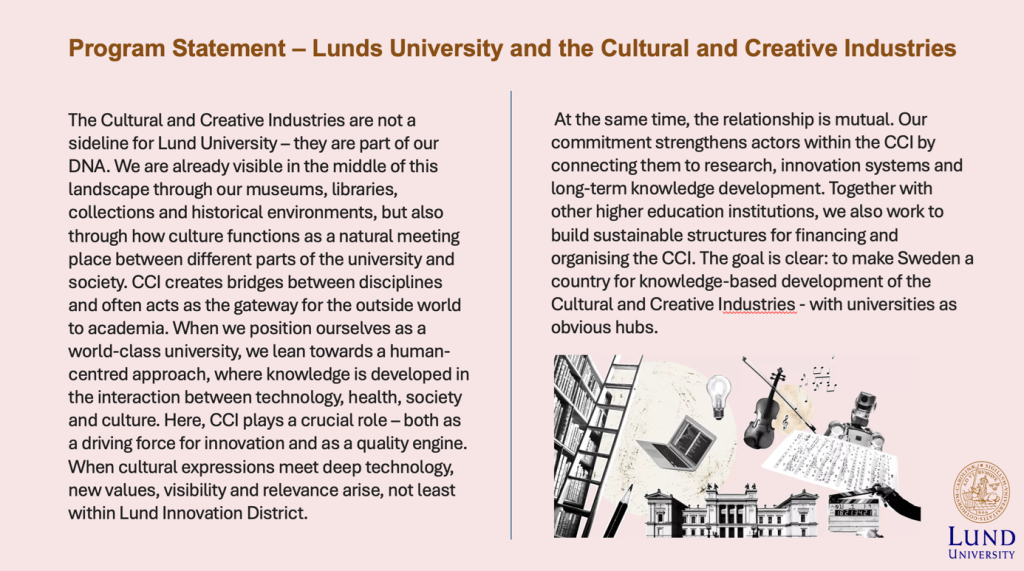
*A “Fourth Generation University” is a concept used in higher‑education and innovation policy to describe a university that goes beyond education, research, and commercialization and takes an active, co‑creative role in shaping society and regional development. In short, it is a university that does not only respond to societal needs but helps orchestrate and lead societal transformation.
Link to: https://www.iva.se/en/Swedish-futures/Essays/the-two-as-in-steam/?epslanguage=en
