Bite size news from LU "KIC Office"

COOOKIES – Collaborations & other Opportunities in Knowledge and Innovation EcoSystems

Grid View

Fashion and AI – new research starts at Campus Helsingborg

Lund University is investing in establishing new research at Campus Helsingborg on how AI is changing practices for the design and consumption of fashion. This will explore ideas that AI can make work more efficient, democratic, and sustainable, but also concerns that creative work is being left to machines, that design can be driven by sales data and that AI can reinforce normative body ideals. The work will include creating an interdisciplinary network and conducting a pilot study. This initiative is part of the project “Fashioning AI: Human and nonhuman designs” and the portfolio on Fashion & Textile Transformation. 

19 November 2025

This entry was posted in

About

Comments

0 Comments Leave a comment

Policies driving Open innovation as a standard in ecosystems

Woman in the foreground and creatives in the background at meeting

During the last week of October, Politecnico di Milano hosted ekip’s “General Assembly” with many rich conversations on how the extensive material – insights, tools and policy recommendations – by ekip can come into play developing ecosystems that better supports the Cultural and Creative Industries. ekip (The innovation policy platform for the cultural and creative industries) is funded within the framework of Horizon 2030 and is led by Lund University (LU Collaboration). Several workshops addressed the question of how all the material developed through the extensive policy development process can be used in different contexts to support the development of ecosystems across Europe.

The material is extensive and of different nature (posters, articles, reports, videos, cartoons etcetera) in order to be used in so-called “policy journeys” at local, regional, national and EU level. The focus is on open innovation to include the Creatives in ecosystems. Particularly important was the discussion of how the work needs to be adapted to developments within the EU, for example regarding the FP10 and the increased focus on competitiveness, resilience, and sustainability. The cultural and creative sector can play a crucial role in this development, but then the Creatives needs to be included in innovation policies. 

The Competitive Compass by the European Commission, sets out a clear agenda: close the innovation gap, decarbonise, reduce dependencies, and create the right conditions for ideas to grow. This is where ekip contributes. We work across Europe to redesign the policies and ecosystems that make innovation possible, and we bring creatives into the early stages of problem-solving and #policy design.

Some of the things we do — our work spans the full innovation cycle:

✔ Policy #recommendations: clear actions to strengthen CCIs within Europe’s innovation systems.
✔ Innovation #portfolios: real-world testing with local stakeholders to see how policy ideas work in practice.

ekip is redesigning the systems that enable innovation, helping Europe turn its creative strength into competitive strength.

Join us in shaping the future of Europe’s innovation ecosystems.
👉 Read about our recommendations here: https://lnkd.in/eU-FhXHs
👉 Read about our innovation portfolios here: https://lnkd.in/e7bkVyAE

14 November 2025

This entry was posted in

About

Comments

0 Comments Leave a comment

Great turnout of the Green Transition Hack

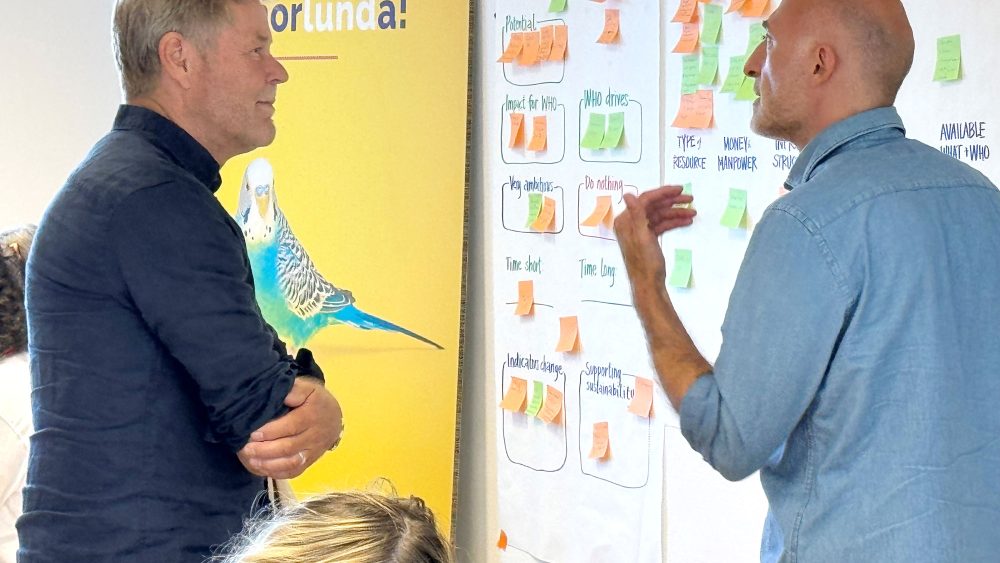
At the Green transition hack, 120 participants gathered to hack solutions for the green transition. During two full days they worked on challenges on food systems, mobility, water reuse and making sustainability reporting trustworthy and comparable. Specialist from our partner organisations supported the groups and provided feedback on their ideas.

Alfa Laval, partner for the third year, says “the Green Transition Hack provides a unique opportunity to engage with students who are focusing on some of our most pressing sustainability challenges. It’s a space for meaningful dialogue, inspiration, and learning.”

A new partner for this year, Tata Consultancy services says “We believe that collaboration between industries, startups, and academia is essential to accelerate progress toward net-zero and circular business models. By partnering with this initiative, we aim to empower new ideas, foster cross-disciplinary innovation, and support solutions that make a measurable environmental and societal impact.”

At the end of the event, three teams were selected as winners. Affan Alam, team member in one of the winning teams, said “What truly stood out to me was how people from diverse backgrounds, speaking different languages, and living different lifestyles could come together so effortlessly to collaborate, disagree, co-create, and ultimately succeed.”

12 November 2025

This entry was posted in

About

Comments

0 Comments Leave a comment

FoSSNet Winter School 12-30 January 2026 on Complex food-system challenges

This EIT Food-related Winter School is organised by Lund University, University of Oxford and the University of Roskilde. It is part of the EU-project FoSSNet that is dedicated to building a long-lasting pan-European network for Food Systems Science. The winter school offers a collaborative learning experience designed for early-career researchers from academia, industry, and applied research turn their work into real-world solutions for today’s complex food-system challenges.

Through collaboration across diverse perspectives, participants learn to apply systems and entrepreneurial approaches to interrogate evidence, co-design practical options, and translate insights directly into their own research practice.

What skills will you practice?

  • How to move from research to application – identifying how your work contributes to change
  • Gain systems-thinking literacy, learning to see problems as part of interconnected food systems
  • Strengthen your impact and communication skills
  • Join a European network of peers and mentors committed to sustainable food-system transformation.

Learn more and sign up!

This is an opportunity for PhD candidates, postdocs, and R&D staff with less than 7 years of experience. It is also open for researchers and practioners working on food-systems topics in academia, research institutes, start-ups, public bodies, or industry.

The winter school consists of three weeks of learning from 12-30 January, divided into three thematic weeks. In the first week, the focus is on understanding the food system as a complex network and problem framing. The second week looks at identifying key actors, leverage points and plausible impact pathways. The final and third week concerns how to translate and communicate research for impact, practicing pitching and adjusting your messaging for different audiences.

Read more about learning objectives, structures and models – and register here!
FoSSNet Winter School | EIT Food Learning Services

10 November 2025

This entry was posted in

About

Comments

0 Comments Leave a comment

Feeding Innovation – Student report from EIT Food “Next Bite” event

Jars with cacao-like content at a fair of future of food

We had the privilege of representing Lund University at the EIT Food Annual Event “Next Bite” in Brussels in October 2025, a dynamic gathering of experts, innovators, and changemakers shaping the future of the European food sector.

Throughout the event, new insights into the challenges, opportunities, and innovations shaping the European food sector were shared. From inspiring conversations to stimulating sessions, the event refreshed our collaborations, expanded our academic networks, and introduced us to many brilliant minds working toward a more sustainable food system. 🥗🥙🌯🌮

Why now matters
We learned that there is an urgent need for a next generation of young and innovative farmers with practical knowledge of sustainable and regenerative agricultural practices. Additionally, to meet EU sustainability goals, public and private collaboration is key. Cellular agriculture and novel fermentation technologies will completely change the game of how we produce food, particularly proteins 🥩🍄, and many exciting innovations are developing in this space.

Thank you EIT Food team at Lund University, for making this experience possible and for the many brilliant people we connected with. We are excited to carry these insights further into our PhD journeys! We leave you with the words of Jack Bobo: “Things are not bad and getting worse. Things are good and getting better…but not fast enough.”

Jennifer Mignonne De Waal and Lena Krautscheid, Doctoral students

Next Bite 2025 Programme – Next Bite 2025

29 October 2025

This entry was posted in

About

Comments

0 Comments Leave a comment

Policy – a multi-faceted concept

Abstract overlapping lines in yellow, orange and grey

ekip is an Innovation Policy Platform for the Cultural and Creative Industries, so in our communication we tend to include “policy” a lot, often in combination with other words. This sometimes leads to confusion, since the concept is rather complex and sometimes used in different ways. Here we try to define some of the more common concepts: policy, policy recommendation, policy area, and policy journey.

The Cambridge Dictionary defines “policy” as

“a set of ideas or a plan of what to do in particular situations that has been agreed to officially by a group of people, a business organization, a government, or a political party.”

In the context of ekip, a policy can focus on issues such as what kinds of organizations are allowed to apply for funding (for example, both SMEs and NGOs) or on selection criteria for invitation to participate in programs or activities (for example, >10 employees). They can also regulate tasks allocated to cultural institutions, for example, if museums are encouraged to support innovation or not. A policy can also define how money is distributed for different kinds of activities and if support is made available. In sum, a policy can focus on many things, but the key is that it is something that (a) a group of people decides upon (b) within some kind of organisation, for example, a municipality. There are also different policy domains, such as cultural policies and innovation policies where ekip aims at bridging the two.

By Lena Holmberg

Read more about policy concepts at ekip website

15 October 2025

This entry was posted in

About

Comments

0 Comments Leave a comment

ekip Policy Lab:Digital Product Passport Unlocking Circularity in Fashion &CCIs

VENUE: Campus Bovisa, via Candiani 72, Milan, Italy
TIME: October 29th 2025; from 10:00am to 16:00pm CET

This ekip Policy Lab will explore how research and innovation (R&I) policies can support the development and scaling of eco-design practices and DPP implementation in the fashion and textile sectors. Particular attention will be paid to the role of CCIs, SMEs, and local ecosystems in furthering this agenda through collaborative innovation frameworks and inclusive governance models. It will explore key challenges and opportunities for implementation of Ecodesign in Sustainable Products Regulation and Extended Producer responsibility.

8 October 2025

This entry was posted in

About

Comments

0 Comments Leave a comment

Have an impact on EU´s future budget – join ekip!

In July 2025, a proposal for the EU’s future budget – the Multi-annual Financial Framework (MFF) 2028-2034 was presented. Although it indicates a significant increase in budget for the Culture and Creative Industries and thus a commitment to strengthening culture and values amidst mounting pressures to invest in economic competitiveness and security, there is still reason to look at its associated conceptual framework. 

In the article ”AgoraEU: Reframing Culture as a Force for Democracy?” research expert Elena Polivtseva at the Goethe Institute points at many uncertainties with the new budget proposal. For example, on the one hand the proposal emphasises the Culture and Creative Industries (CCI) contribution to the EU’s identity, inclusive and participatory governance, active citizenship, equality, and non-discrimination is recognized, but at the same time[ML1] , the new funding instrument AgoraEU falls under the heading of Competitiveness, prosperity and security. She also points at its lack of an ambitious vision for culture as a driver of the EU’s global role and as a transformative tool for navigating today’s complex geopolitical realities.

Since the budget is still a proposal, it is important to provide decision-makers with policy development support and participate in the debate. Especially since AgoraEU will serve as one of the key tools for implementing the Culture Compass Europe.

Creating a link between research and policy

This discourse is a central target for the policy recommendation work done in the EU flagship [ML2] initiative ekip, led by Lund University. It supports the development of policies that make open innovation into the new standard in ecosystems and drive innovation policy that empowers CCIs to make a significant impact on Europe’s societal, environmental, and economic transformation it. The way that ekip make use of the knowledge co-developed in EU funded projects and initiatives like the EIT Culture & Creativity KIC, creates a link between research and policy development. 

The importance of ekip and the EIT Culture & Creativity KIC is emphasised in the report “Unleashing the Potential of the Cultural and Creative Industries”. It was published by the DG Research & Innovation at the EU Commission in spring 2025.

The ekip platform and policy engine can become an important, even central, element in an overarching EU-wide CCSI ecosystem with a focus on pooling and transforming research outputs into policy recommendations and on further nurturing research on and for CCSIs. To this can be added a platform for exchange and cooperation among all kinds of CCSI stakeholders as a nucleus for an emerging culture- and creativity-driven innovation ecosystem. To avoid any constraints on the creation of an EU-wide impact from the budget of EUR 6 million and a project duration of three years, ekip must seek close cooperation and joint structures with other networks, platforms and support initiatives for CCSIs to agree on a common approach and to jointly implement common goals. The way ekip and EIT Culture & Creativity embark on a common approach will be key.” (p. 58)

Do you want to have a role in forming the policies for the next EU budget period? Make sure to join the ekip community!

29 September 2025

This entry was posted in

About

Comments

0 Comments Leave a comment

Insights from a student at the Fast-forward Plant-based Symposium

As the newly elected student representative in the Lund University team for the EIT Food KIC, I got the opportunity to accompany two fantastic colleagues to the “Fast-forward Plant-based food Symposium” in Copenhagen. The conference focused on how we can transition to a more plant-based food system with a focus on Denmark and Europe – a step towards reduced greenhouse gas emissions, better public health, increased biodiversity and improved animal welfare.

As a master’s student in sustainability science, I see major challenges in the agricultural sector, and plant-based diets can be an important part of the solution. During the conference, we took part in insightful panel discussions with experts from universities, civil society, the agricultural sector, the European Parliament, the Danish government, the business community, the financial sector and municipalities. A recurring insight was the need for stronger public-private partnerships to drive the transition forward. It also became clear that both farmers and innovators must be at the centre of the shift to a plant-based diet.

A European strategy for the transition is needed

There was a lively debate about whether deregulation and reduced bureaucracy could speed up the process — or whether other strategies were needed. However, the message was clear: the transition to a plant-based food system should be carried out efficiently and decisively, as it is a transition, not a revolution. In general, the experts agreed that a European strategy is needed, with Denmark serving as a role model.

I met with the CEO of EIT Food KIC and had a pleasant conversation about his motivations and current trends in food innovation in Europe. During networking meetings, I also got in touch with an Lund University alumnus who now works with sustainable food systems in Brussels — an inspiring meeting that made me think about my own career in the field.

To sum up, joining the conference, I gained valuable insights into plant-based food systems, forged new relationships and strengthened my understanding of the innovation ecosystem that EIT Food-KIC is involved in.

Kim Sensener

15 August 2025

This entry was posted in

About

Comments

0 Comments Leave a comment

Sign up to our Newsletter!

Confetti mixed colors on teal colored background

Do you want to stay updated with news about calls, events, new opportunities for learning or collaboration in the EIT KICs and related ecosystems for knowledge and innovation?

Sign up for our newsletter – get COOKIES!

Get updates on new activities, events, opportunities for learning, networking and funding in Knowledge and Innovation ecosystems.


1 August 2025

This entry was posted in

Okategoriserade

Comments

0 Comments Leave a comment

About Food KIC

A ypung couple choosing food items in a store by a shelf

Lund University is a strategic partner in EIT Food, the world’s largest food innovation community. EIT Food is directed towards three missions: Healthier lives through food, Reducing risk for a fair and resilient food system, and Net zero food system.

Lund University is co-leading a food master in close collaboration with EIT and European partner universities. Lund University is engaged in several EIT Food activities, such as think tanks and innovation projects.  

Lund University is also strongly connected to various innovation ecosystems related to the food system, such as Food and Biocluster Denmark and regional food and biotech networks.

9 April 2025

This entry was posted in

About

Comments

0 Comments Leave a comment

About Climate KIC

Flood protection sandbags with flodded homes in background. People in rescue boat in city

The Climate-KIC collaboration office at Lund University (climate-KIC@lu) works with researchers, students and external organisations to initiate activities and develop projects for climate mitigation and adaptation. By knowledge sharing, facilitating networking opportunities, and organising relevant activities, the office fosters collaboration and mobilises actors in the green transition.

One of its key initiatives is the annual Climathon. In 2024 over 120 people participated in Climathon and tackled climate challenges from partner organisations such as Tetra Pak, Alfa Laval, Kraftringen, Lund Municipality, and Malmö City. The office also supports Lund University’s involvement in Viable Cities and is currently conducting a pre-study on battery recycling.

Since joining Climate-KIC in 2016, Lund University’s activities have developed, adapting to changes in Climate-KIC’s funding and support structures.

Flood protection sandbags with flodded homes in background. People in rescue boat in city
Flood Protection Sandbags with flooded homes in the background (Montage)
9 April 2025

This entry was posted in

About

Comments

0 Comments Leave a comment

Older Posts